Saturday, December 08, 2007
County Birding: Roseate Spoonbill

Thursday, December 06, 2007
Wildbird
Saturday, December 01, 2007
Hawk Watching
1. Your name, address, phone number and E-mail address
2. The date and specific location of the sighting
3. The species of hawk, if possible
4. Which leg the aluminum band is on
5. The letter or number and color of the band, as well
as any marks before the letter or number
6. The location and proximity to any known hawk nests
7. Any information about breeding behavior, such as courtship, nest building, territorial behavior and/or repeated vocalizations
Thursday, November 22, 2007
Nix Nature Center
Unfortunately, with all my pre-Thanksgiving errands, I didn't make it there until 3pm only to find out they lock the gates at 4pm... darn. So I quickly peeked into the center to see what it was like, then stuck close to the parking lot and birded the sycamores. I had wanted to get back further in, since two of the research projects I'm interested in working on are conducted at the Laguna Coast Wilderness Park.
As always, you can click on the photos to enlarge them for a better look.

It was a monoculture of yellow-rumped warblers - and every one I saw was the Audubon's variety. There were a few golden-crowned sparrows, and some white-crowned sparrows, juveniles and adults both, feeding in the buckwheat. There were lesser goldfinches saying their downward slurred "peeewww" and wrentits with their bouncing ball call.
The area was a perfect example of why those wildfires a few weeks back raged out of control, it was bone dry. They did a good job on the native vegetation around the center, there was laural sumac, buckwheat, stream monkeyflower, coyote bush, encelia, and some others I recognized, but couldn't recall a name for. A red-tailed hawk circled over the parking lot, signaling my time to leave, it was nearly 4, and I don't think my family would appreciate me being locked in the parking lot all night since I'm the one cooking our dinner tonight!
Another photo you should probably click on to see the birds atop the buckwheat...

Click the phrase above to see my post from last year with all sorts of facts about Thanksgiving's mascot, the turkey...
Tuesday, November 20, 2007
Birding @ UCI
Monday, November 19, 2007
11th Annual CVBS Recap

After lunch on Saturday the young birders as well as a few others went to Staten Island Rd. to get a little afternoon birding in. These flooded agricultural fields yielded few new species like Greater White-fronted Geese, Horned Larks and a Rough-legged Hawk. This was also a good spot to get a look at the Sandhill Cranes prevalent in the Central Valley. 
Tuesday, November 13, 2007
Birding @ UCI
There were winter migrants like the Ruby-crowned Kinglets and Yellow-rumped Warblers vocalizing loudly. At least two gorgeously marked Townsend's Warblers were foraging in the sycamores.
A House Wren was calling loudly, and allowed me to get close enough that binoculars would have been virtually useless, before flying to safety. Song Sparrows and Black Phoebes were present as expected. As were the multiple Anna's Hummingbirds flying around large red flowers.
A Downey Woodpecker gave me a bad case of "warbler neck" as I strained to see it near what seemed at the time like the top of the tallest tree in the park.
Although it was a mere twenty minutes without the aid of even a pair of binoculars, I felt refreshed for having been able to sneak a little birding into what is otherwise a very busy school day!
Orange County Great Park
The park is set to include among other things: a 2.5 mile canyon, a 20+ acre lake, a 974 acre nature preserve, a Wildlife corridor linking the Cleveland National Forest to the Laguna Coast Wilderness Park, Botanical Gardens, a Great Lawn.

The giant orange air balloon, which will take people over the park is already open and fully opperational. It offers free rides in 2007.
Wednesday, November 07, 2007
Orange County Society for Conservation Biology

This evening I attended a meeting of the Society for Conservation Biology, where guest speaker Scott Thomas gave a short slideshow on the raptors of Orange County. I also had the opportunity to hear about a couple of exciting research opportunities that I may decide to work on for the winter or spring quarters. They are pretty diverse: Scott's research with Red-tailed Hawks, a survey of the endanged plant species, the Laguna Beach Live-forever, and one involving using motion actived cameras to track the movements of large mammals at Laguna Coast Wilderness Park.
Tuesday, November 06, 2007
Central Valley Birding Symposium

I have attended the CVBS for the past two years now, and enjoyed every year, gaining lifers, and new birding contacts, among other things. I'm sure many of you heard about the Ross's Gull that disrupted the symposium last year! My post from last year can be found here...
hope to see you there!
Monday, November 05, 2007
Klamath Basin Water Crisis

This choice to divert water was prompted by the fact that the area supports an endangered species of fish - the shortnosed suckerfish. It is also a critical stop on the pacific flyway and supports large numbers of migrating birds, namely Bald Eages and is an important ground for American White Pelicans. The farmers were outraged that their crops were being threatened to protect a suckerfish, so they turned to illegal means to get their water. Opening floodwalls that were diverting the water to allow it to drain into their irrigation canals.

The local police were not willing to do anything about these actions because they sided with the farmers.
The bullet points below are an excerpt from this website: http://www.klamathbasin.info/2003costs.pdf
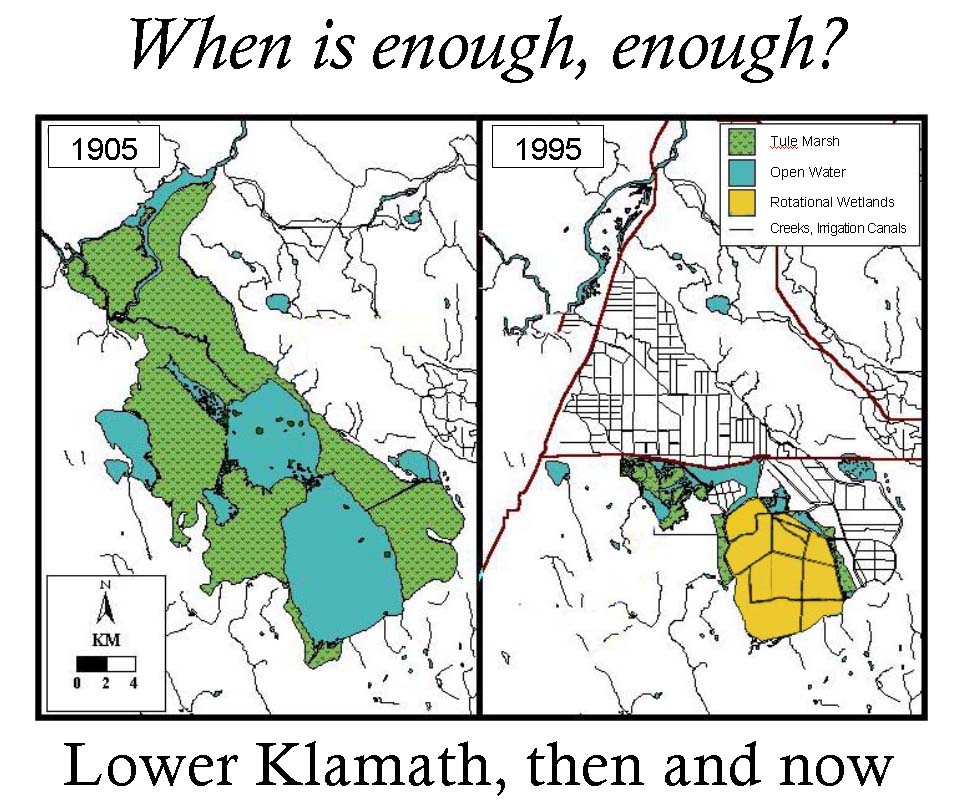
Lower Klamath, Tule Lake, and Clear Lake National Wildlife Refuges Impacts
• The 2003 plan estimates–but does not guarantee–a 22,000 acre-feet water delivery to Lower Klamath and Tule Lake refuges. This represents the smallest water delivery to the refuges in 41 years.
• U. S. Fish and Wildlife Service documents indicate 2002 was the sixth year out of the last 13 when the refuges received no water in the fall, when peak waterfowl migration occurs. The 2003 plan almost guarantees a seventh year of dry refuges. This chronic lack of water degrades marsh habitat, disrupts waterfowl migration, and reduces the food supply for threatened bald eagles.
• The Upper Klamath Basin supports the largest seasonal concentration of bald eagles in the Lower 48 states, and Tule Lake and Lower Klamath refuges contain much of the key wintering habitat for these eagles (Keister et al., 1987). The 2003 plan supplies 10,000 acre-feet less water than required in 2001 to prevent a die-off of bald eagles.
• The 2003 plan threatens California’s only remaining breeding colonies of American white pelicans, and two of the last fifteen colonies remaining in the world, located within Lower Klamath and Clear Lake refuges. Low water levels expose pelican nesting islands to predators, which can cause the mass desertion of nests and young. According to the California Department of Fish and Game, destruction of nesting islands and breeding habitat has caused a precipitous decline in pelican numbers. As of early April, three of Clear Lake’s four pelican nesting islands were already land-bridged by low water levels and unsuitable for nesting.
• Combating avian botulism–a disease that can kill thousands of birds on the refuge in a single outbreak–requires the ability to alternatively flood or drain different parts of the refuge. Refuge water shortages insure the increased prevalence of botulism by preventing essential water management.

Upper Klamath Lake and Upper Klamath National Wildlife Refuge Impacts
• The 2003 plan will eliminate the lake’s marsh habitat–essential to both endangered fish and migratory waterfowl–for four solid months. The plan calls for lowering Upper Klamath Lake water levels below 4140 feet in elevation from August through December, and for levels at or below 4139 feet from August through November. When the lake falls below 4140 feet, bordering marshes start going dry. Roughly half of the lake’s marshes will have no water at 4139.5 feet. Below 4193 feet, all of Upper Klamath Lake’s marshes will be completely dry. Under the plan, all 14,400 acres of Upper Klamath
• Development of Water Supply Production Wells for Lower Klamath NWR, Final EA, USFWS 2001, p. 26 refuge marshes will remain dry from August through November, leaving thousands of acres of critical refuge wetlands dry during the fall migration of waterfowl and other birds. Other marshes left dry by the plan include the Klamath Game Management areas at Squaw Point, Shoalwater Bay, and marsh restoration projects along the lake.
• The plan’s low lake levels will increase the likelihood of algae blooms and related mass die-offs of endangered suckers in the late summer and early fall. Higher water levels can decrease the duration and intensity of such algae blooms (Laenen and LeTourneau 1996; Noges et al, 1997; Welch and Burke 2001; Sheffer 1998), thereby minimizing the likelihood of a recurrence of the devastating adult fish kills observed in 1995, 1996, and 1997.
• Lowered lake levels will cut off suckers from essential spawning habitat around the lake. Loss of spawning grounds is one of the principle factors in the decline of the lake’s sucker populations. Lowered levels will also cut off access to the cool, clear waters of lakeside springs and creeks, where fish often take refuge from the lake’s often lethal water quality conditions.
• The lake’s wetland areas provide critical safe havens for young Lost River and shortnosed suckers, which use marshes to escape predators. The dramatic, long-term loss of marsh habitat under the Bureau’s plan will greatly reduce their chances for survival, and impact sucker populations for generations to come.
• The plan’s long-term low lake levels will worsen Upper Klamath Lake’s already extreme water quality problems. Leaving the marshes dry from August through November will eliminate the positive water-filtering function of the lake’s bordering wetlands. In addition, chronically dry marshes may become a source of poor water quality: exposed marsh peat soils can oxidize, releasing nitrogen and phosphorous. When water finally returns to the marshes, these pollutants wash into the lake and increase water quality problems.
Saturday, November 03, 2007
November at SJWS
We walked around to the ponds farther back, where Drew pointed out a lone western grebe diving for fish. Continuing to make our way toward the front ponds, we saw a great-blue heron sitting in a cottonwood tree, the poor tree bent nearly in half under it's weight. In the pond opposite the meadow we found a large white pelican feeding. The vertical drop of the hunting Forster's terns surprised Drew. I love birding with people who don't consider themselves birders, its a treat to watch them ooh and aah over birds that we've become so accustomed to over the years. I really need to get out birding more often...
Here's a list in banding code of the species we saw:
- PBGR
- WEGR
- AWPE
- DCCO
- GBHE
- GREG
- SNEG
- BCNH
- GADW
- NOPI
- AMWI
- NOSH
- CITE
- GWTE
- RUDU
- RSHA
- AMCO
- SORA
- SEPI
- KILL
- AMAV
- BNST
- SPSA
- LBDO
- FOTE
- MODO
- ANHU
- ALHU
- NUWO
- NOFL
- BLPH
- SAPH
- CORA
- AMCR
- HOWR
- MAWR
- RCKI
- HETH
- COYE
- SPTO
- WCSP
- FOSP
- SOSP
- RWBL
- GTGR
- HOFI
- AMGO
Thursday, November 01, 2007
Birds in the News

This YariguÃes Brush-Finch was news itself when it was discovered in Colombia, South America. It was described in the Bulletin of the British Ornithologists Club (Vol. 126: June 2006).
First off, today the British Trust for Ornithology kicked off the largest bird survey ever to take place in Britain. It is a four year project with more than 50,000 volunteers. To learn more, click here...
Monday, October 22, 2007
Southern California Wildfires
View Larger Map
The Santiago Fire, as it is now being called, is buring some of my favorite birding locations, including Modjeska Canyon and Silverado Canyon where I have gotten multiple lifers and birded many times over the years.
Here is a link also provided at Amy Hooper's blog: Wildbird on the Fly.
The smoke and ash are choking the air here, and my own campus, UC Irvine, is canceling outdoor classes and recreation, and making allowances for absences due to evacations of local homes, as well as health hazards for students with asthma and other respiratory complications.
This map has a lot more detail about the exact locations and various containment of the multiple fires.
The biggest problem are the bark beetle infestations which have killed out and dried out the local forests, as well as this extended drought that California has been suffering. I have family and friends who have been evacuated from their homes, so we're all crossing our fingers here...
Thursday, October 18, 2007
A Different Kind of Duck
I am a big hockey fan, but for those of you who aren't, the Ducks (formerly the Mighty Ducks) won the Stanley Cup this past spring, which is like the Superbowl of hockey. So far this season, the team has been doing quite well, and my boyfriend and I have had the good fortune to be at the games - two rows up behind the Duck's bench to be exact. Hopefully I'll have some time this weekend to see the other ducks in Orange County =)
Wednesday, October 10, 2007
Fall PRBO Birdathon
Saturday evening around 6:30pm, we headed to Peter's Canyon and picked up a few species to start the list, including among other species, ring-necked duck and black-throated gray warbler. We went to Irvine Regional Park and picked up western screech-owl and had a barn out actually fly in over our heads as well. Sunday morning at the sunless hour of 5am, we met at SJWS to consolidate into one car, and as we headed out, we were greeted with the sight of two bobcats running across the road, white tails flashing as they passed through our headlights, a good luck omen!
We got our rail species at UNB, and continued on along the coast, picking up the black oystercatchers and Cresent Bay, and my county yellow-headed blackbirds at Crystal Cove State Beach.
We birded north to Huntington Central Park, which gave us a few species, including a dusky flycatcher, but the winds had picked up making things quieter than any birdathon team would like, so we made a group decision to head inland where we still needed quite a few basic species for our list.
A stop at Irvine Lake, a spot not normally birded, yielded my lifer of the day, a sage thrasher! as well as quite a few other needed species. Then to Tucker Wildlife Sanctuary, where we gained some basics like California quail, and fox sparrow.
With a quick stop to pick up some lunch, we moved on to Irvine Regional Park, which did not give us the target species we expected to get, so we moved on towards the coast. Bolsa Chica was a good spot, as it usually is for the coastal shorebirds, gulls, and terns.
We ended our day back at the marsh where we had left our cars, and were able to add a few final species to our list. We also observed some photographers down in one of the ponds that had dried down enough to allow dry land in the basin. I highly disapprove of that behavior, a good shot is never worth it if you are disturbing the sanctuary that is being provided to the wildlife you are photographing.
All in all it was a very good day birding, despite the winds making the birds hunker down, and wearing us out perhaps more than we would have been otherwise. Our species list, while still being revised for the next few days seems to have ended at 134 species total.
Friday, September 28, 2007
Small World
I was shopping with a friend at South Coast Plaza today, and as we walked out to our car, the man parked across from me asked what my license plate meant, and introduced himself as Bob Morse, co-author of Birds of the Los Angeles Region. He offered me a signed copy of the book, which I readily accepted since I hadn't purchased it yet =)
Saturday, September 08, 2007
Arctic Warbler in Kern!

Ironically, we were discussing how the bird probably didn't show up all by itself, and lo and behold today we hear that there are actually TWO Arctic Warblers at Galileo!
I'm actually a little disappointed with how my photos came out, they just don't do the bird or the views we got of it justice... maybe it's time to buy a new lens... ;)
Friday, September 07, 2007
Wednesday Birding at SJWS
Mason Park
Monday, September 03, 2007
The Demographics of Birding
Heat Wave

The flock was comprised of avocets, marbled godwits, a few dowitchers and a lone red knot mixed with some ring-billed gulls, caspian terns and one or two elegant and royal terns mixed in. Moving on, some long-billed curlews were walking around lazily in the heat. I walked over to the Big Canyon loop trail to get under the shady cover of the sycamores, and found a very active and brave little wren who foraged for insects only a few feet from me out in the open and completely ignoring the clicks of my camera as I shot photos.

I birded for another 15 minutes or so, then the heat got to me and I began feeling light-headed, which I took at my cue to head indoors for lunch.