Tuesday, November 06, 2007

Central Valley Birding Symposium

It's that time of year again, time for the Central Valley Birding Symposium. This has been one hectic year for me, what with transitioning to UC Irvine, and taking my first round of midterms and all, but I have a light at the end of the tunnel... the last of my midterms coincide with the weekend of the CVBS!! Three full days of birding in Stockton, California.

I have attended the CVBS for the past two years now, and enjoyed every year, gaining lifers, and new birding contacts, among other things. I'm sure many of you heard about the Ross's Gull that disrupted the symposium last year! My post from last year can be found here...

hope to see you there!

Monday, November 05, 2007

Klamath Basin Water Crisis

I'm writing an essay in my environmental analysis and design course, and I found the subject so interesting, I thought I'd share. It's on the water crisis in the Upper and Lower Klamath Basin starting in 2000 (it compares the Klamath issue to a similar one in Montana). The area had been in a severe drought, and so the EPA decided to divert 33% of the water flow that normally goes to irrigation of crops on the many farms in the area, to the Klamath Lake and Tule Lake and surrounding rivers.

This choice to divert water was prompted by the fact that the area supports an endangered species of fish - the shortnosed suckerfish. It is also a critical stop on the pacific flyway and supports large numbers of migrating birds, namely Bald Eages and is an important ground for American White Pelicans. The farmers were outraged that their crops were being threatened to protect a suckerfish, so they turned to illegal means to get their water. Opening floodwalls that were diverting the water to allow it to drain into their irrigation canals.

The local police were not willing to do anything about these actions because they sided with the farmers.

The bullet points below are an excerpt from this website: http://www.klamathbasin.info/2003costs.pdf
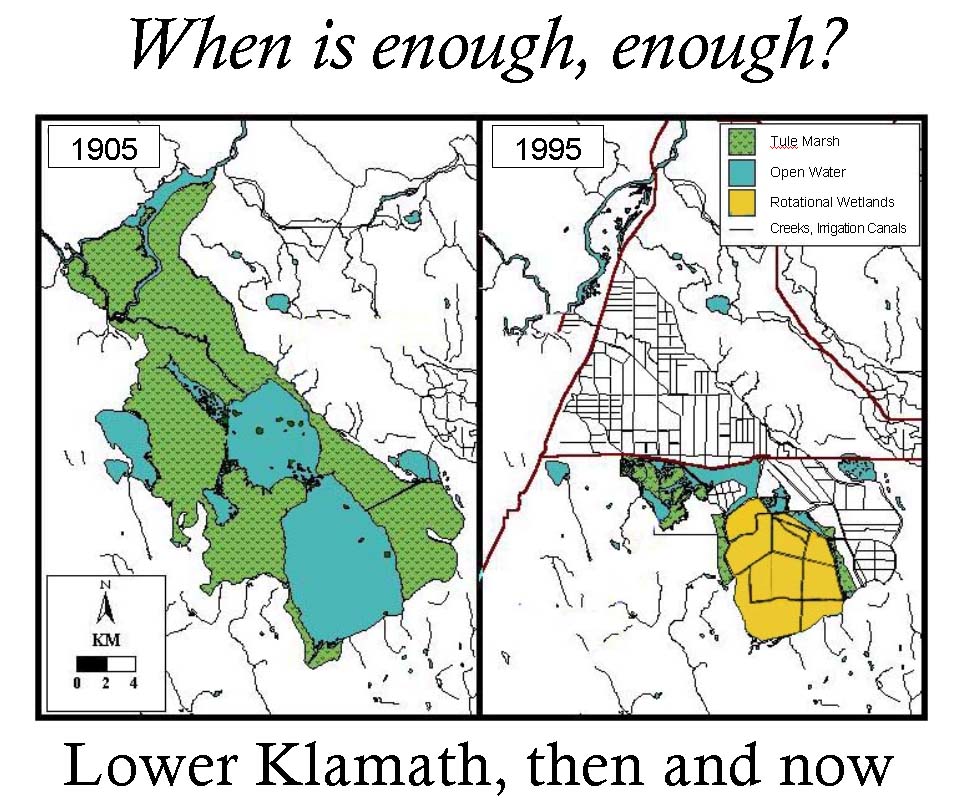
Lower Klamath, Tule Lake, and Clear Lake National Wildlife Refuges Impacts

• The 2003 plan estimates–but does not guarantee–a 22,000 acre-feet water delivery to Lower Klamath and Tule Lake refuges. This represents the smallest water delivery to the refuges in 41 years.

• U. S. Fish and Wildlife Service documents indicate 2002 was the sixth year out of the last 13 when the refuges received no water in the fall, when peak waterfowl migration occurs. The 2003 plan almost guarantees a seventh year of dry refuges. This chronic lack of water degrades marsh habitat, disrupts waterfowl migration, and reduces the food supply for threatened bald eagles.

• The Upper Klamath Basin supports the largest seasonal concentration of bald eagles in the Lower 48 states, and Tule Lake and Lower Klamath refuges contain much of the key wintering habitat for these eagles (Keister et al., 1987). The 2003 plan supplies 10,000 acre-feet less water than required in 2001 to prevent a die-off of bald eagles.

• The 2003 plan threatens California’s only remaining breeding colonies of American white pelicans, and two of the last fifteen colonies remaining in the world, located within Lower Klamath and Clear Lake refuges. Low water levels expose pelican nesting islands to predators, which can cause the mass desertion of nests and young. According to the California Department of Fish and Game, destruction of nesting islands and breeding habitat has caused a precipitous decline in pelican numbers. As of early April, three of Clear Lake’s four pelican nesting islands were already land-bridged by low water levels and unsuitable for nesting.

• Combating avian botulism–a disease that can kill thousands of birds on the refuge in a single outbreak–requires the ability to alternatively flood or drain different parts of the refuge. Refuge water shortages insure the increased prevalence of botulism by preventing essential water management.

Upper Klamath Lake and Upper Klamath National Wildlife Refuge Impacts

• The 2003 plan will eliminate the lake’s marsh habitat–essential to both endangered fish and migratory waterfowl–for four solid months. The plan calls for lowering Upper Klamath Lake water levels below 4140 feet in elevation from August through December, and for levels at or below 4139 feet from August through November. When the lake falls below 4140 feet, bordering marshes start going dry. Roughly half of the lake’s marshes will have no water at 4139.5 feet. Below 4193 feet, all of Upper Klamath Lake’s marshes will be completely dry. Under the plan, all 14,400 acres of Upper Klamath


• Development of Water Supply Production Wells for Lower Klamath NWR, Final EA, USFWS 2001, p. 26 refuge marshes will remain dry from August through November, leaving thousands of acres of critical refuge wetlands dry during the fall migration of waterfowl and other birds. Other marshes left dry by the plan include the Klamath Game Management areas at Squaw Point, Shoalwater Bay, and marsh restoration projects along the lake.

• The plan’s low lake levels will increase the likelihood of algae blooms and related mass die-offs of endangered suckers in the late summer and early fall. Higher water levels can decrease the duration and intensity of such algae blooms (Laenen and LeTourneau 1996; Noges et al, 1997; Welch and Burke 2001; Sheffer 1998), thereby minimizing the likelihood of a recurrence of the devastating adult fish kills observed in 1995, 1996, and 1997.

• Lowered lake levels will cut off suckers from essential spawning habitat around the lake. Loss of spawning grounds is one of the principle factors in the decline of the lake’s sucker populations. Lowered levels will also cut off access to the cool, clear waters of lakeside springs and creeks, where fish often take refuge from the lake’s often lethal water quality conditions.

• The lake’s wetland areas provide critical safe havens for young Lost River and shortnosed suckers, which use marshes to escape predators. The dramatic, long-term loss of marsh habitat under the Bureau’s plan will greatly reduce their chances for survival, and impact sucker populations for generations to come.

• The plan’s long-term low lake levels will worsen Upper Klamath Lake’s already extreme water quality problems. Leaving the marshes dry from August through November will eliminate the positive water-filtering function of the lake’s bordering wetlands. In addition, chronically dry marshes may become a source of poor water quality: exposed marsh peat soils can oxidize, releasing nitrogen and phosphorous. When water finally returns to the marshes, these pollutants wash into the lake and increase water quality problems.

Saturday, November 03, 2007

November at SJWS

I took my boyfriend Drew out birding with me this morning at SJWS. It was a cool, foggy morning that felt just right for November. We found plenty of ducks on the ponds - northern pintails, northern shovelers, ruddy ducks, American widgeons, gadwalls, green-wing teal and cinnamon teal. We walked around the first few ponds, then headed across the boardwalk into the back area where I have been wandering more and more recently.
There was a hermit thrush calling, and spotted a fox sparrow, one of my favorites, scraping alongside the trail. We heard a Nuttall's woodpecker calling, and when I looked up to point it out to Drew, in the same tree was a northern flicker. Although he is not officially a birder, he was impressed by the pied-billed grebe in the small creek that had caught a fish and was struggling to swallow it.
Great Marsh Evening Primrose

We walked around to the ponds farther back, where Drew pointed out a lone western grebe diving for fish. Continuing to make our way toward the front ponds, we saw a great-blue heron sitting in a cottonwood tree, the poor tree bent nearly in half under it's weight. In the pond opposite the meadow we found a large white pelican feeding. The vertical drop of the hunting Forster's terns surprised Drew. I love birding with people who don't consider themselves birders, its a treat to watch them ooh and aah over birds that we've become so accustomed to over the years. I really need to get out birding more often...


Here's a list in banding code of the species we saw:

  1. PBGR
  2. WEGR
  3. AWPE
  4. DCCO
  5. GBHE
  6. GREG
  7. SNEG
  8. BCNH
  9. GADW
  10. NOPI
  11. AMWI
  12. NOSH
  13. CITE
  14. GWTE
  15. RUDU
  16. RSHA
  17. AMCO
  18. SORA
  19. SEPI
  20. KILL
  21. AMAV
  22. BNST
  23. SPSA
  24. LBDO
  25. FOTE
  26. MODO
  27. ANHU
  28. ALHU
  29. NUWO
  30. NOFL
  31. BLPH
  32. SAPH
  33. CORA
  34. AMCR
  35. HOWR
  36. MAWR
  37. RCKI
  38. HETH
  39. COYE
  40. SPTO
  41. WCSP
  42. FOSP
  43. SOSP
  44. RWBL
  45. GTGR
  46. HOFI
  47. AMGO

Thursday, November 01, 2007

Birds in the News

I thought I'd do a little compilation of the current news involving birds...


This YariguĂ­es Brush-Finch was news itself when it was discovered in Colombia, South America. It was described in the Bulletin of the British Ornithologists Club (Vol. 126: June 2006).
First off, today the British Trust for Ornithology kicked off the largest bird survey ever to take place in Britain. It is a four year project with more than 50,000 volunteers. To learn more, click here...

Next in the news is Rwanda, where the Office of Tourism and National Parks has recognized that bird-watchers provide a golden economic opportunity. To read on, click here...

In less pleasant news, Prince Harry, as in the prince of England, is being questioned in an investigation of the killing of two endangered Hen Harriers, two of only 521 breeding pairs in Britain. He was hunting in the area, but said he had no knowledge of the incident. To see the story, click here...

Monday, October 22, 2007

Southern California Wildfires

I'm sure by now many of you have heard about the multiple (I think the number is up to around 17) wildfires burning between Santa Barbara and San Diego - the closest one to me being the Irvine/Orange County fire which was started by arson. The fires began late Saturday or Sunday, raging through the wilderness areas and even communities. The Santa Ana winds - hot dry winds blowing out towards the ocean from inland - have stoked the flames.

View Larger Map
The Santiago Fire, as it is now being called, is buring some of my favorite birding locations, including Modjeska Canyon and Silverado Canyon where I have gotten multiple lifers and birded many times over the years.
Here is a link also provided at Amy Hooper's blog: Wildbird on the Fly.
The smoke and ash are choking the air here, and my own campus, UC Irvine, is canceling outdoor classes and recreation, and making allowances for absences due to evacations of local homes, as well as health hazards for students with asthma and other respiratory complications.
This map has a lot more detail about the exact locations and various containment of the multiple fires.
The biggest problem are the bark beetle infestations which have killed out and dried out the local forests, as well as this extended drought that California has been suffering. I have family and friends who have been evacuated from their homes, so we're all crossing our fingers here...

Thursday, October 18, 2007

A Different Kind of Duck

Well, I haven't had much opportunity to bird in the past few weeks, but I have had a chance to watch a different kind of duck... the Ducks of Anaheim - hockey!

I am a big hockey fan, but for those of you who aren't, the Ducks (formerly the Mighty Ducks) won the Stanley Cup this past spring, which is like the Superbowl of hockey. So far this season, the team has been doing quite well, and my boyfriend and I have had the good fortune to be at the games - two rows up behind the Duck's bench to be exact. Hopefully I'll have some time this weekend to see the other ducks in Orange County =)

Wednesday, October 10, 2007

Fall PRBO Birdathon

I had the good fortune to be asked again by Vic Leipzig if I'd like to be on his fal PRBO birdathon team. I of course said yes because I had enjoyed the Sea and Sage Birdathon I did in the spring. The team consisted of myself, Vic, Roy Poucher, and Steve Sosensky.

Saturday evening around 6:30pm, we headed to Peter's Canyon and picked up a few species to start the list, including among other species, ring-necked duck and black-throated gray warbler. We went to Irvine Regional Park and picked up western screech-owl and had a barn out actually fly in over our heads as well. Sunday morning at the sunless hour of 5am, we met at SJWS to consolidate into one car, and as we headed out, we were greeted with the sight of two bobcats running across the road, white tails flashing as they passed through our headlights, a good luck omen!

We got our rail species at UNB, and continued on along the coast, picking up the black oystercatchers and Cresent Bay, and my county yellow-headed blackbirds at Crystal Cove State Beach.
We birded north to Huntington Central Park, which gave us a few species, including a dusky flycatcher, but the winds had picked up making things quieter than any birdathon team would like, so we made a group decision to head inland where we still needed quite a few basic species for our list.

A stop at Irvine Lake, a spot not normally birded, yielded my lifer of the day, a sage thrasher! as well as quite a few other needed species. Then to Tucker Wildlife Sanctuary, where we gained some basics like California quail, and fox sparrow.

With a quick stop to pick up some lunch, we moved on to Irvine Regional Park, which did not give us the target species we expected to get, so we moved on towards the coast. Bolsa Chica was a good spot, as it usually is for the coastal shorebirds, gulls, and terns.

We ended our day back at the marsh where we had left our cars, and were able to add a few final species to our list. We also observed some photographers down in one of the ponds that had dried down enough to allow dry land in the basin. I highly disapprove of that behavior, a good shot is never worth it if you are disturbing the sanctuary that is being provided to the wildlife you are photographing.

All in all it was a very good day birding, despite the winds making the birds hunker down, and wearing us out perhaps more than we would have been otherwise. Our species list, while still being revised for the next few days seems to have ended at 134 species total.

Friday, September 28, 2007

Small World

I was shopping with a friend at South Coast Plaza today, and as we walked out to our car, the man parked across from me asked what my license plate meant, and introduced himself as Bob Morse, co-author of Birds of the Los Angeles Region. He offered me a signed copy of the book, which I readily accepted since I hadn't purchased it yet =)

Saturday, September 08, 2007

Arctic Warbler in Kern!

Yesterday I was sitting at my computer editing photos from Mason Park when my old roomate Matt told me that an Arctic Warbler had just been seen in Kern County. Because it would be a lifer, I desperately wanted to chase it, but I didn't want to drive out to the desert by myself, especially since my car is a little too far past its scheduled oil change.
I was able to catch a ride with a young birder from Riverside. We drove for 3 hours, hoping that it would be there and that we could see it and get home in one night. When we finally got there, we saw a crowd of birders watching it and ran over to see it. The bird was foraging completely oblivious to our camera clicks and coming so close we could almost have touched it. We watched it making circles around the cottonwoods, and then finally got back on the road towards home.

Ironically, we were discussing how the bird probably didn't show up all by itself, and lo and behold today we hear that there are actually TWO Arctic Warblers at Galileo!

I'm actually a little disappointed with how my photos came out, they just don't do the bird or the views we got of it justice... maybe it's time to buy a new lens... ;)


Friday, September 07, 2007

Wednesday Birding at SJWS

I spent some time in the afternoon at SJWS on Wednesday, but this morning was the first chance I got to edit the photos I took. It was not so much a birding day as it was butterflies and dragonflies. I saw at least 4 or 5 species of odes and 3 or 4 leps. It was sunny and warm, but not as oppressively hot as it had been in the first part of the week.
The birding was decent, but nothing really unexpected showed itself, it was pretty late in the day for warblers, only a few OCWAs and a WIWA or two showed up. The Yellow-breasted Chat was a welcome sight, I don't see those little buggers as often as I'd like...

Mason Park

I birded Mason Park this morning around 7am, my apartment is so close I can ride a bike there now. It was nice and cool and quite birdy. The fall migration has clearly begun because the orange-crowed warblers were out in abundance, and there were plenty of wilson's warblers and yellow warblers as well. I saw two warbling vireos and a black-throated gray foraging in the sycamores, but couldn't seem to get a good photo of anything to save my life, I guess that means I'll be spending more time at Mason this fall trying for those nice warbler shots =)

Monday, September 03, 2007

The Demographics of Birding

I'm working on a final for a research class I'm taking this summer, and I came across this very interesting PDF that I thought I'd share. It's a demographic analysis of birders in the United States, and it's very thorough... check it out HERE, or if you prefer, its the first link on the top of this Google search.

Heat Wave

So I'm not entirely sure why I felt it would be a good idea to go birding in the middle of the day during a heat wave in Southern California, but I did. I went to Upper Newport Bay around 11:30 and the birds were suprisingly active when I walked up. A large mixed flock of shorebirds sat on the edge of the waterline and talked and milled around quite a lot. An osprey circling far off may have provided the reason for this afternoon activity.

The flock was comprised of avocets, marbled godwits, a few dowitchers and a lone red knot mixed with some ring-billed gulls, caspian terns and one or two elegant and royal terns mixed in. Moving on, some long-billed curlews were walking around lazily in the heat. I walked over to the Big Canyon loop trail to get under the shady cover of the sycamores, and found a very active and brave little wren who foraged for insects only a few feet from me out in the open and completely ignoring the clicks of my camera as I shot photos.

I birded for another 15 minutes or so, then the heat got to me and I began feeling light-headed, which I took at my cue to head indoors for lunch.

Sunday, August 26, 2007

Visitors

Friday I got to bird with some friends from out of town. A fellow youngbirder and old friend Sean and his friend Tom were on a birding vacation from Wisconsin, and stayed with me while in Orange County. My old roommate David drove down from Ventura to join us as well. We birded the coast, starting down at La Jolla Cove to look at seabirders. We got black-vented shearwaters, and the usual coastline stuff like brown pelicans, brants cormorants, and heerman's and western gulls galore. Common dolphins and harbor seals provided some non-bird entertainment.

From there, we drove to Mission Bay where we picked up good mixed flocks of shorebirds and some little blue herons. David had a chance to practice his sign-language on a few people out on the spit allowing their dogs to run around chasing birds, including endangered species like least terns.... grrrrrr.

We then moved on to San Elijo Lagoon, where we saw a lot of the same species, but added yellow warblers and nuttall's woodpeckers, as well as a few more shorebird species. No sign of the black tern being reported there, but the boys had just birded the Salton Sea, so black tern wasn't a real big miss as far as they were concerned.

We then headed back into Orange County, stopping at Cresent Bay in Laguna Beach, another good spot for some seabirds. We added rocky shorebirds like surfbirds and turnstones, as well as many black storm-petrels farther out. The ocean mammals were abundant, with Risso's Dolphins swimming on the horizon.

Next it was off to Bolsa Chica, where we saw the reddish egret, and savannah sparrows, as well as more least terns. This is where I left them, to get some stuff done on my own. They continued birding until nightfall then David headed back home, and Sean and Tom crashed at my place one more night before a very early plane ride home.
Can you guess who's scope is the shortest one?

Friday, August 10, 2007

August Birding

Well for the first time in ages, I had a morning free to go birding. It was already 75 degrees at by 9am when I arrived, and it did not cool off at all. It was slightly more subdued than I'm used to, due to the heat, but I had the marsh to myself, seeing only one couple walking during my entire two hours there.


I saw dozens of white-throated swifts flying around, and lots of Wilson's phalaropes in the third pond. The butterflies and dragonflies outnumbered the birds, with Lorquin's Admirals, Western Tiger-Swallowtails, and multiple species of dragons flying around.


The lizards were also out basking in the sun, and skuttled away whenever I came too close. At one point, I saw a european honey bee struggling in a web, the spider waiting patiently just out of reach. The bee managed to disentangle itself and flew to the mulefat nearby to continue gathering pollen


Tuesday, July 24, 2007

Road Trip Summer 2007

Hey all, if you've been wondering whether or not I've fallen off the face of the planet, fear not, I'm still here! I've been on the road since July 5th with my boyfriend driving across the country to visit his family in North Carolina. We left So Cal in the afternoon on July 5th (I had to go to orientation for my upcoming summer classes at UC Irvine) and took Interstate 40 East the entire way to NC. That night we drove until about 11pm and stayed in Arizona.
Wildflowers from a gas stop in Oklahoma

Our second day on the road we left bright and early and stopped a couple times to rest, eat, and gas up. I got out at one rest stop and took some photos while Drew got a little shut-eye since he did all the driving those first few days. We spent that night in Oklahoma.
This moth is so large, it looks and flies like a hummingbird


Same routine for the next day, Drew drove and I birded out the window, Scissor-tailed Flycathers were a treat, suprisingly common on the telephone lines alone the road. One stop to gas up in Arkansas produced an exciting lifer for me, a White-eyed Vireo, and an American Snout butterfly as well! We drove at least 16 hours that day and made it to North Carolina by 4am.

This White-eyed Vireo was very active and hard to photograph!

This American Snout butterfly was a lifer for me

We spent the next day relaxing and I birded his parent's yard, which held a couple lifers for me, especially since I haven't been out to the east coast since becoming a serious birder. Eastern Towhees, Red-headed Woodpeckers, Tufted Titmice, Carolina Chickadees, Ruby-throated Hummingbirds and Northern Cardinals, were just a few of the birds I saw while there.

Anyone care to I.D. these frisky beetles?


We flew up for a business-related trip to New York, which was exciting for me even though there wasn't much time for birding, as it was my first trip to NYC.

These adorable baby bluebirds were nesting in Drew's parent's mailbox, she put a note for the mailman so he wouldn't shove mail into their nest!


We spent another few days in North Carolina relaxing, celebrating his birthday, and enjoying the time with his family, then it was time to drive up to Philidelphia to visit other relatives. I saw my very first fireflies ever, and much to his amusement, I ran around the yard chasing them for a few minutes.

Black-billed Magpies were all over the place in Colorado

Finally we got on the road towards home, this time taking the more northern Intersate 80 West all the way to Denver where we stayed with his uncle one night, then on to Steamboat Springs, after sitting parked on the I-70 for nearly two hours while a mudflow was being cleared off the highway, to stay one night with my cousins, ride the alpine slide and enjoy the natural hot springs there - which I highly recommend, but are clothing optional after dark - so we left far before night fell =)

These workers were busy clearing the remains of the mudflow that trapped us on the I-70W for a little over two hours

From Steamboat it was a single days drive home to lovely Southern California!

I think I I.D.ed this butterfly already, but I've forgotten what it was, so anyone?