Saturday, October 22, 2011
Friday, October 14, 2011
Yosemite!
My new home for the next two and a half months - Yosemite National Park.
I'm going to be guiding hikes and snowshoeing trips at the Evergreen Lodge outside Hetch Hetchy Valley through the end of December. It's absolutely breath-taking here and I can't wait to get hiking. I don't have the best internet connection (and no cell service) but I will try and blog from time to time to update about anything cool I experience.
Tuesday, October 04, 2011
Two Harbors, Catalina
I spent the weekend out in Two Harbors on Santa Catalina Island - an island in the channel island chain. While the purpose of the trip was for fun and to visit old friends from my time working out there, I did get a bit of birding in on the beach. On Monday, after the big Buccaneers Days event was over and all the pirates had sailed for home, the isthmus was pretty empty. Apparently a large bait ball of fish had been using the boats for cover, and they were left exposed. ALL the birds from "Bird Rock" - so called for a huge colony of pelagic cormorants, gulls, and brown pelicans that live there - drove them into the harbor in a feeding frenzy.
A few people were on dinghy boats or kayaking when the birds descended and all they could do was watch and hope not to be landed on or worse while the flock was overhead! It was phenomenal to watch the huge flotillas of cormorants diving from the surface as the pelicans bombed down from above, and the western and Heermann's gulls drove the small fish onto shore to pick off. It finally died down and a friend, who had run out to swim in the midst of it and try for a few bigger fish that could have been feeding on the school, said that there was nothing left but scales raining down in the water. Amazing.
Wednesday, September 28, 2011
Aliso & Wood Canyon Wilderness Park
Had an awesome hike in Aliso & Wood Canyon Wilderness Park today.The weather was sort of overcast and misty, probably a thick marine layer that never quite burned off. I saw all sorts of good birds, including a loggerhead shrike, some lark sparrows, and a bunch of raptors including, a red-tailed hawk, Cooper's hawk, American kestrel, and a white-tailed kite.
Aliso Woods
Find hiking trails in California
Monday, September 26, 2011
Bommer Canyon Hike
I went for a short, 4 mile out and back hike in Bommer Canyon today. Since the City of Irvine took over the property, its been made public, but access has also been changed dramatically. Now instead of driving in to the staging area to hike out, there's a mustard-filled "nature loop" that you must take to get to the real trail. Definitely took away some of the pleasure of the trip to have to hike out to the start of the real hike in flat, monocultured, unshaded land.
Caterpillar Phacelia
Stinking Gourd
California Buckwheat
Trail
Monday, July 18, 2011
Harding Canyon/Modjeska Canyon
Went for a short hike this morning with a non-birder friend. We decided to follow the creek at Harding Canyon, which is accessible from behind Tucker Wildlife Sanctuary in Modjeska. It was a sunny cloudless day, so birding was pretty subdued. A chipping sparrow flock greeted us on our ascent to the trailhead, but the highlight bird sighting was definitely three rock wrens feeding in the dry riverbed.
It was great to get back out in my beloved riparian and chaparral habitat again. We saw a great mix of natives, and the insects were out in abundance. We had Lorquin's Admirals, some whites, and even a Marine Blue hanging out in some deerweed. The dudleya were in bloom on the hillsides amongst the white sage. We hiked up the creek bed until we found running water.
Hiking along a stream is always a treat, since wildlife is so much more abundant. We had dragonflies paroling the waterway, tiny frogs hanging out on the rocks, and tadpoles zipping around in the water.
We were only out for a short while since we both had other obligations for the day, not to mention the heat that would have driven us inside before long even if we had the entire day.
Here's a few more of the random shots from the hike:
Tuesday, July 12, 2011
Some DC Photos
I took this photo during the Christmas Bird Count in Maryland.
This shot was taken from my apartment balcony in Silver Spring, MD. I may be a California girl through and through, but this really was a beautiful view.
Saturday, July 02, 2011
Birding/Lep-ing with Hunter Around OC
Today I went birding/leping with a former camper of mine. We hit Harriett Wieder Park first for a look at the Lesser Sand-Plover that's been hanging out there. Gorgeous bird and super easy tick off to start the day. We then headed up Silverado Canyon to do some birding and butterflying. The weather was incredibly hot and clear, great for butterflies, not so good for birding. It was so wonderful just to be outside again, even if it was pretty quiet bird-wise. We had California Dogfaces flying around near all the stream crossings at the base of the canyon. We found a gorgeous lily that I think might have been a Weed's Mariposa Lily. I forgot to bring my camera, which put a kink in IDing plants we didn't recognize. Higher up we had an Acmon Blue, and a number of sulfurs we weren't able to identify - one smaller and more vividly yellow, another larger and pale lemon-y yellow.
Bird-wise, we had ash-throated flycatchers, yellow warblers, a singing black-headed grosbeak, and a single mountain chickadee. As it got even hotter, we headed toward Dilly Preserve and the Nix Nature Center where we had a few more butterfly species, including a Mormon's Metalmark and Square-spotted Blue. The heat finally drove us to call it quits, but it was such a joy to spend time out in nature again, and all the great butterfly sightings had me kicking myself for not bringing my camera... guess it's time to wipe off the dust and get back out there!
Butterfly List:
- Tiger Swallowtail
- Mourning Cloak
- California Dogface
- Acmon Blue
- Mormon Metalmark
- Square-spotted Blue (or whatever its new name is)
- American Lady
- Cabbage White
- 2 Sulfur Species (Cloudless?)
- Gray Hairstreak
Monday, December 06, 2010
Tuesday, October 26, 2010
Solar Powered Roads
Solar powered roads make absolute sense for the Southwestern United States. It harnesses the solar energy that these roads already attract. The opportunity to add in the messages to the roads is also a great one, making night driving much more safe. Cost may be an impediment, but as petroleum costs rise, even asphalt roads will be pricier. This is a step in the right direction for sure.
Wednesday, October 20, 2010
Open Season: Sandhill Cranes
I wanted to pass along a very distressing blog post from a fellow birder and blogger on the hunting of Sandhill Cranes throughout the Central Flyway. I was stunned to read that there is hunting allowed for this species.
Now, just my two cents here, but I do not oppose hunting. I'm a vegetarian, and don't hunt or even eat meat myself, but hunters are often some of the largest supporters of conservation initiatives in America. After all, you can't hunt it if the species dies out, or there's no land to hunt on. I'm all for sustainable hunting practices, and in some places, deer management is an integral part of the wildlife management plans. However, a species like Sandhill Cranes does not fall on my "okay to shoot at" list. I don't know how hard this would hit the population, but unless it can be proven to be a sustainable practice, I would be against it.
Take a moment to read her blog post, learn about Tennessee's controversial practices, and make an informed decision for yourself about how you feel about the issue of crane hunting.
If it bothers you, pass along the story to raise awareness, and consider taking an even more active role by writing to your local representatives, or trying to get your local conservation groups involved.
Thursday, October 14, 2010
Audubon Naturalist Society
I've been working as a Contract Naturalist with the Audubon Naturalist Society in Chevy Chase, MD. Not to be confused with the National and local Audubon Society, which I have worked with in the past. I am doing nature-themed birthday party programs, scout programs, etc on a contract basis.
They're a lot of fun, and you get a small dose of environmental ed, kids, and often are force-fed birthday cake ;) What a great opportunity for a part-time job to keep my environmental education resume current, get my fix of teaching and working with kids, and get to get outdoors to play around for a bit every few weekends! Yippie!
Wednesday, September 15, 2010
Window Strike Wednesday
Well this morning, I woke up to an extremely depressing sight. I was on my way out of the building to work, and found a perfect worm-eating warbler lying dead on the pavement. Window strikes are the number one cause of mortality in birds annually. While everyone likes big windows in their home or office to let in natural light, and give them a beautiful view to contemplate, most don't realize that birds - having no concept of glass - fall prey to those windows.
"Between 100 million and 1 billion birds die from crashing into glass every year in North America alone, according to Audubon Magazine; they are either confused by the reflections in windows or simply can’t see the glass, and fly into it at full speed."
I want desperately to help people become aware of this issue, because there are so many workable solutions out there to solve this problem. There are films that you can buy to adhere to your glass that make it visible to birds, without obstructing your view. There is also bird-friendly glass out on the market that uses technology borrowed from spider webs to make glass visible to birds while keeping the glass clear to the human eye. With so many options, both high tech, and low, expensive and cheap, we should be able to keep birds from meeting their demise at the expense of our view.
Groups like City Wildlife's Lights Out DC, Lights Out Chicago, Lights Out New York, and FLAP exist to try and raise awareness, yet most Americans have never even considered the fact that glass is such a deadly killer - it's worth spreading the word!
![]() |
| http://www.sibleyguides.com/conservation/causes-of-bird-mortality/ |
Tuesday, August 24, 2010
Canoeing on the Potomac
Saturday I went canoeing on the Potomac River with some new birder friends. One worked for the Potomac Conservancy, and needed to do an informal survey of invasive plants on an island owned by the Conservancy. We paddled out to Minnie's Island, with some difficulty since the water level was so low and the area rocky. We enjoyed great looks at a very active Green Heron, and then pulled the canoe out and hiked around the island, looking at plants, bugs and birds.
It was so lush and green, and the hum of cicadas so loud I felt like I was in a tropical forest in South America, or back in time. A native sunflower bush was attracting droves of Eastern Tiger-Swallowtails and Monarchs.
We birded around and discussed the various invasive plants, trying to ID them and and figure out how best to go about doing a removal and restoration. The high water line was well overhead, which really gives you goosebumps when you realize the ground you're standing on could, and has been, under water.
After we finished surveying the island, and feeding the happy mosquitos, we got back in the canoe and paddled up-river for a while. We saw what at first looked like a stick bobbing toward us, as it came closer, we realized what we were looking at was a water snake - swimming with an eel in it's mouth! It swam under the boat, and to a rock where it lost the eel. I felt sorry because I wondered if our paddling in for a closer look had distracted the snake enough for the eel to twist away. I hope it wasn't our fault he lost his lunch. He was a big gorgeous snake, probably a brown water snake. So exciting!
It was definitely the highlight of the day, and after paddling up a bit further, we headed back to the boat launch and hauled the canoe back up to the lockhouse, then headed home. It was a great morning and although I had so many mosquito bites coating my legs it looked like chicken pox, I was extremely happy to have gotten out on the water.
Tuesday, August 17, 2010
Reminiscing About Texas, 2006
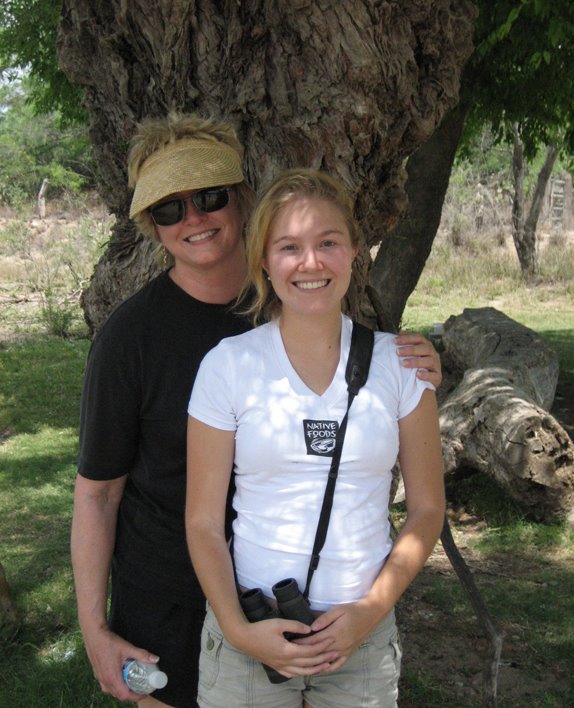
I was Wildbird Magazine's 2005 Birder of the Year, which won me a trip to Texas in early spring of 2006. Here's the recount article that I wrote for the July/August 2006 issue of WildBird:
The trip to the Rio Grande Valley of Texas was an incredible experience. We--my mom, Amy Hooper and I--started off the trip by spotlighting for Common Pauraque on Saturday with Sheridan Coffey and Martin Reid. We walked along the water at Bentsen-Rio Grande Valley State Park. When we finally saw a pauraque fly, it became my first lifer of the trip. My nonbirding mom unexpectedly enjoyed the outing so much that she chose to bird with us for the rest of the trip.
Sheridan and Martin enthusiastically guided us for the first two days. On Sunday, we first stopped at Anzalduas County Park (956-585-5311) and saw Black-bellied Whistling-Ducks, a quirky species. The Turkey and Black Vultures (a lifer) riding a thermal over the park provided an unexpected surprise. We also saw Golden-fronted Woodpeckers, a Northern Parula, Couch’s Kingbirds, Great Kiskadees and a magnificent Scissor-tailed Flycatcher.
On our way back to Bensten, I spotted my life Harris’ Hawk. Once at Bensten, we got our first look at Green Jays, and on a feeder, we watched a Long-billed Thrasher, an Altamira Orioleand an Indigo Bunting take turns. In a photo blind, we heard Plain Chachalacas calling from all sides.
Next stop: Santa Ana National Wildlife Refuge, where we birded with intern Heidi Trudell. Life birds included Black-crested Titmouse and Roseate Spoonbill. We sat to wait for the day’s last lifer, a Buff-bellied Hummingbird.
On Monday, we visited the hawkwatch at Santa Ana and saw Broad-winged Hawks, Mississippi Kites and many others overhead. The lift-off was breathtaking. Up the river at Chapeno, we picked up Ringed Kingfisher from a distance as well as Brown Jays, one juvenile and one adult. We later parted ways with Martin and Sheridan and headed to San Benito.
Tuesday morning, Pat Wade joined us as our guide, and we quickly got my first lifer of the day: Tamaulipas Crows carrying nesting material. Then we went to the Sabal Palm sanctuary, where I got my life Carolina Wren singing on a branch. We also saw the controversial Gray-crowned Yellowthroat.
The Aplomado Falcon (unbanded) and the White-tailed Hawk provided roadside treats on the way to South Padre Island, an amazing place. My last lifer of the trip was Upland Sandpiper off-island, and like my first Texas lifer, I lost a pint of blood to the mosquitoes in order to get it.
I gained more than 40 new birds, enjoyed fantastic experiences and met some superb people. To top it off, my mother gained a better understanding of who I am and what birding is. I’d say that alone made it a successful trip.
The trip to the Rio Grande Valley of Texas was an incredible experience. We--my mom, Amy Hooper and I--started off the trip by spotlighting for Common Pauraque on Saturday with Sheridan Coffey and Martin Reid. We walked along the water at Bentsen-Rio Grande Valley State Park. When we finally saw a pauraque fly, it became my first lifer of the trip. My nonbirding mom unexpectedly enjoyed the outing so much that she chose to bird with us for the rest of the trip.Sheridan and Martin enthusiastically guided us for the first two days. On Sunday, we first stopped at Anzalduas County Park (956-585-5311) and saw Black-bellied Whistling-Ducks, a quirky species. The Turkey and Black Vultures (a lifer) riding a thermal over the park provided an unexpected surprise. We also saw Golden-fronted Woodpeckers, a Northern Parula, Couch’s Kingbirds, Great Kiskadees and a magnificent Scissor-tailed Flycatcher.
On our way back to Bensten, I spotted my life Harris’ Hawk. Once at Bensten, we got our first look at Green Jays, and on a feeder, we watched a Long-billed Thrasher, an Altamira Orioleand an Indigo Bunting take turns. In a photo blind, we heard Plain Chachalacas calling from all sides.
Next stop: Santa Ana National Wildlife Refuge, where we birded with intern Heidi Trudell. Life birds included Black-crested Titmouse and Roseate Spoonbill. We sat to wait for the day’s last lifer, a Buff-bellied Hummingbird.
On Monday, we visited the hawkwatch at Santa Ana and saw Broad-winged Hawks, Mississippi Kites and many others overhead. The lift-off was breathtaking. Up the river at Chapeno, we picked up Ringed Kingfisher from a distance as well as Brown Jays, one juvenile and one adult. We later parted ways with Martin and Sheridan and headed to San Benito.
Tuesday morning, Pat Wade joined us as our guide, and we quickly got my first lifer of the day: Tamaulipas Crows carrying nesting material. Then we went to the Sabal Palm sanctuary, where I got my life Carolina Wren singing on a branch. We also saw the controversial Gray-crowned Yellowthroat.
The Aplomado Falcon (unbanded) and the White-tailed Hawk provided roadside treats on the way to South Padre Island, an amazing place. My last lifer of the trip was Upland Sandpiper off-island, and like my first Texas lifer, I lost a pint of blood to the mosquitoes in order to get it.
I gained more than 40 new birds, enjoyed fantastic experiences and met some superb people. To top it off, my mother gained a better understanding of who I am and what birding is. I’d say that alone made it a successful trip.
Subscribe to:
Posts (Atom)